As the year draws to a close, I am compelled to take time to reflect on all that has taken place this past year. What I discover in this deeper dive, is that all of us have been subjected to constant trauma. All our senses have been assaulted, and if we have not felt the pain from these assaults, just wait.
I am not here to convince you to believe me, or to shame you for doing or thinking what you might about this virus, nor is it my desire to judge or debate with you about all the actions that have been and are being taken by our governments. Rather, I want to ask you this question: does the continued polarization of our population, our society, and our very culture have a good outcome? Where will it lead if we have a society that is broken across a perceived public health status? What might that look like and how does that prospect make you feel? Regardless of your answers to these questions, is this the only way forward—do we have to pick sides? What happens if we don’t pick a side, is that an option? If we follow the actions in some countries, like Austria for example, not picking a side is not going to be an option. What then? I would argue that there are options but they don’t involve picking sides.
Earlier this week, my wife and I were having a discussion about the idea of a Third Way, that is this notion that there is a way forward that does not involve the tragic consequence of opposites. I told her that back in 2007 I wrote a paper titled, Wisdom and the Apocalypse—Refracted through the gateway of the Liberal Art of Dialectica, and the “Erotic Sciences” of alchemy, astrology, sacred art, and the wisdom tradition of the Kabbalah. I spent some time searching an old backup disk and found the paper. After pulling up this paper I shared it with my wife, whose initial response was to tell me that what I wrote in 2007 was nothing short of prophetic and that it contained words and thoughts that must be shared today. I admit I was a more than a little flattered by what she said because I have never thought of myself as that good a writer or someone anyone might listen to. That being said, I decided to share some of what I wrote on this blog – why not. Before I upload the actual edited paper, let me just paste here my reasons for writing this paper back in 2007.
“…It is with this background that I sit down to write about the paradox and wisdom of apocalypse. It is a paradox because our culture has defined apocalypse as something final, a termination, an ending of life as we know it, with little regard or respect for the kernels of creation that can flow from such events; and wisdom, because in the margins of the terror and the fear, wisdom—that can only be divine— unfolds. If only we knew how not to be swallowed up by the darkness, but rather, to be present with the energy and discover the wisdom hidden in the margins.
As I explore the paradox and wisdom of the apocalypse in the pages that follow, I hope to convey to the reader, that it is a dualism of thought and form, in fact an illusion created by our minds, that continues to trap us in a cycle devoid of hope. Until we can let go of this dualistic idea of good and evil, light and darkness, and give into the nothingness that is God, we will continue to be entangled by the dangers that lie within.“
Here I am, fourteen years later, and I find myself blown away by my own words. Without further ado, here is the paper. In the next few days I will start to write about what I think this Third Way could look like.
The Wisdom – Apocalypse Paradox
“Das ewig Weibliche zieht uns hinan” (The eternal Feminine (Wisdom) draws us upward)[1]. I like this image from the Chorus Mysticus in Faust of being drawn upward by the Divine Feminine (Sophia) and I see it as a backdrop against which we are born. Once born into this world we are immediately thrust into a reality full of opposites and we come face-to-face with the ultimate question that seems to arise from our experience of life and self-reflection. This is the fundamental experience of the pain the suffering and the death that are part of life and upon deeper reflection are felt to be embedded into the very matrix of the universe. This paradox of feeling drawn upward by the Divine Feminine, Wisdom, Sophia, from the very heart of our being while concurrently clashing with the absurdities, injustice and catastrophes of life has been referred to by philosophers and theologians alike as the tragic contradiction[2]. It is not just the tragedies of life experienced on a personal level but also those experienced on a communal and universal level. We see that beyond the personal pain and suffering there are cosmic catastrophes, biological, sociological, ethical, racial, sexual and national and international conflicts. This observation of opposition and contradiction is not new and in fact has driven humankind to search for explanations and solutions. Countless mystics through the ages have stated that the solution comes to us from the ultimate hidden unity of the One who dwells “behind the wall of the coincidence of opposites” and “miraculously combines the opposites, so that they cannot destroy each other, so that conflict is suddenly transformed into harmony.”[3] Hegel[4] says that Wisdom is to be found where philosophy and religion meet but how does this explain the terror and heartache that has been brought about by religion; what is the wisdom in this? I believe that it is in this space-between the opposites, this infinite realm where the antinomies arise and dialectic begins and if we are willing to look inward and let go of our need to control the space we might just discover the power and love in true dialogue.
It is that place where according to Aristotle we, ‘learn the art of dealing in contradictions, of discovering and resolving antinomies.’[5] He has a beautiful description of the antinomies in his dialectical discussion of the harmony that can arise from opposition and conflict. In the famous maxim of Heraclitus the classic Platonic question is raised regarding this subject: “Between whom do friendship and love exist, between equals or between opposites?”[6] In answer to this he quotes Euripides saying that “parched earth loves the rain, and stately heaven when filled with rain loves to fall to earth.” Aristotle goes on further and offers the following solution:
“But perhaps there is no real attraction between opposites, as such, but only accidentally, and what they actually desire is the mean between them (since this is for the Good); the dry for instance striving not to become wet, but to reach an intermediate state, and so with the hot and everything else.”[7]
This space between is where the inner and the outer world come together, in effect they are wedded in what alchemists have called the hieros gamos or sacred marriage; the coming together of opposites giving birth to a new stage of being. As was stated by René Querido, “…the Christ in us is born and we can now fully partake in our Divine son/daughtership.”[8] I cannot fully understand how this happens, for although I have witnessed this transformation in myself, it seems that more often than not the transition is unconscious and I only observe its fruits. These observations have convinced me that the space between is Divine, and while it transects space and time it is not subject to space and time. I believe that it is the experience of living in the space between that prompted Yeshua to say to his disciples that the Kingdom of God is here now and it is within you.[9]
Kabbalah and the Tree of Life
According to the Kabbalah each aspect of creation and each person is a miniature Tree of Life. Each of us has a physical, emotional, intellectual, and spiritual shape contained within ourselves that can be compared to the DNA that forms the patterns upon which all life is based. The kabbalistic approach to this says that, The Tree of Life is modeled in triads, that can be used on a personal level to become aware, to awaken to our Divine nature and become part of creation. Contained within is a model for connection to one another and to the One.
The Tree of Life is represented by ten circles. (Figure 1 – Tree of Life) These circles (sefirot) are drawn in three vertical lines, the center or trunk is represented by four sefirot and two vertical branches, one on either side of the trunk, representing three sefirot each. Study and reflection by kabbalist have revealed that each of the two opposing aspects work in opposition to each other with a third that lies in the middle on a moving equilibrium point between the two opposing sides. The sefirot triplets of the Tree of Life are shown below.
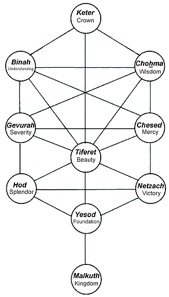
According to the Kabbalah if we look at Chesed which is defined as the quality of expansiveness, mercy and generosity we see that it is that part of us that gives in even when another part of us says no. It is that part that wants to give to anyone that has a need, embrace the suffering and those who are without. Uncontrolled it has the potential to smother the other, it has no self-limitation, no boundaries; it knows only how to give. Gevorah is the quality of contraction, severity and restraint, it is that part of us that wants to hold back, not give away the family jewels. At its best it protects us and ensures that we have sensible boundaries. In contrast to Chesed it stands in opposition to generosity. In its extreme Gevorah prefers things just as they are, it is stifling, rigid and hypercritical. It resists change, is closed off and gives the appearance of being introverted. These two opposites interact with each other but are none-the-less in opposition and at times we feel this opposition. Because these two poles push and pull one another something is needed to mediate between the two. This balance point is tiferet and it serves as the middle path. Kabbalah defines tiferet as beauty and compassion, to ensure that we are neither too selfish nor too expansive. But as noted by Rabbi David A Cooper, Tiferet is, “not merely the passive consequence of the two opposing forces” of generosity and restraint, “…but it possesses a third quality that is drawn from the trunk of the Tree of Life itself.” [10]
When considering the antinomial nature of Wisdom and Apocalypse and the question of the tragic contradictions I am particularly struck by the wisdom in this ancient symbol of the Tree of Life. The Kabbalah says that the lower sefirot represent ordinary consciousness, basically all the things that go on in our minds. However, in order for us to move beyond the realm of the physical universe we must become aware of that which is beyond ourselves, that which is known only through quiet and reflection – in stillness. Different names are used by different cultures to describe these higher levels of consciousness and in Kabbalah it is called chochma / binah consciousness. Chochma is defined as nothingness, or literally translated, as wisdom, and binah is defined as the element of understanding. Both of these on their own are useless; for example, we may hear great wisdom (chochma) but without the benefits of binah (understanding) we have nothing. It is only when we put chochma together with binah that we have knowledge (daat). This is the critical third way, a miracle, the tertium datur[11]; it is the way forward, toward a new way of being, that was not present before, or at least not in awareness.
Apocalypse and the Battle of Opposites
Parts of our world seem to be immersed in violence and evil, we don’t have to look far for evidence that we seem to be slipping into or perhaps, even living in hell. Our collective inhumanity is not limited to what we do to each other but also to life itself, leaving the very planet that we depend upon for our survival, at risk of extinction. The very garden that we have been given to care for and to nurture simply may not survive our greed and selfishness. The dialectical development of opposites is everywhere, and it seems that we are chained to a drama that in itself is unjust and offers us a fate similar to Prometheus or Socrates. When considering the mystery and magic of creation, it is difficult to understand what is to be gained in having living beings oppose one another. We live in a world where differing opinions, unresolved rage and greed, can lead to war and unspeakable violence against each other and the planet. Upon examination, it seems obvious that opposites oppose one another much like the poles on a magnet, and just like a magnet in extreme situations they cannot tolerate one another. In the face of continued violence toward one another and our planet, our growing lack of concern toward the poor and elderly, extremes in wealth, greed, anger, hate and revenge we seem like a species bent on destruction. Under these circumstances, opposition can become intolerable and it is this outcome that leads to suffering, death and tragedy. This pattern seems to be our history, and yet it cannot simply be that one group with one belief, and another group with a contrary belief, are like opposite poles of a magnet and are doomed to repel one another. Could there be factors other than belief and the continuing battle of opposites at work here, wherein a solution lies?
History is replete with evidence of cultures that after centuries of conflict and violence have finally lifted themselves up and found a way to make a lasting peace, to bury the hatchet. Collectively we seem to use whatever reason we can to avoid addressing these contradictions. We delude ourselves into thinking we are spiritually and intellectually mature, judging others and trying to control their lives. Meanwhile telling ourselves that it is the beliefs and practices of others that are holding us back and preventing peace, that only if everyone was as mature or prayerful or ‘religious’ as us, only then we would have peace and harmony. It is this argument that we use to justify preemptive war, the death penalty, assassinations, corporate greed, lying and a whole host of other acts of violence against ourselves and each other. In reality it is our own hate and fear that holds us back and delivers us to the same hell occupied by the very people we wish to destroy. I believe that it is our own lack of awareness, to the beauty and wonder of creation, and to the mastery of the Divine, which has led to the hate and much of the violence in the world. We seem unable to consider the possibility that darkness cannot exist without light, that The Divine, is master of all – darkness and light. Instead we seek to define the nature of the Divine in our own image and to this god we give attributes and characteristics. We say my god is on my side; my god will destroy you, for you are evil. If God is everything and there is only God, then what is evil or darkness or light or anything? Everything is God (Lâ ilâha illâ llâh[12]) and as said in the Nicene Creed of 325 CE, there is nothing seen or unseen which is not God. This realization should bring us to our knees, in humility and gratitude, but instead we have arrogantly created our own destruction through the emergence of a collective vision of apocalypse, that sees the world we know collapsing into itself with only the ‘righteous’ surviving. Our hubris is the darkness that grips our collective soul, and unless we are willing to empty ourselves and allow the darkness to swirl around us, we will never see the light.
Throughout time there have been mystics from around the world who have seen the destruction that will come if we don’t awaken. Such visions of apocalypse have been raised in the myth of the Rig Veda, the Upanishads, and again presented throughout the books of the Bible the Qur’an. When considering the antinomial nature of reality, and the paradox of unity that exists, we must first understand and embrace the possibility that it is through these coincidences of opposites and tragic contradictions, that many wonders and new discoveries are possible, but only if we choose to become aware. It would seem that the very notion of opposites can lead to conflict or to union, and it may well be dependent on our capacity to reach for solutions, through our very awareness of the polarity that exists, or to descend into the complete dialectical development of opposition where as Heraclitus said, “war is the father of all things.”[13] “Opposites are bonded to each other” says Vysheslawzeff, “not by indifference but rather connected by hate;”[14] Aristotle says that, “opposites destroy one another.”[15] Another view of apocalypse is offered by Hobbes, who calls this state of affairs “a time of Warre, (sic) where every man is Enemy to every man.”[16] We have possibly reached a point in our history, where not just every man and woman, but also every part of creation might arise against the violence and abuse simply out of sheer repugnance, and a demand for a solution. When we witness the wild violence of nature, it’s difficult not to imagine that the earth herself, a living organism, is retching in response to the abuse and disregard for life.
Moving Beyond the Opposites
We have been talking about the problem of opposites and how, in the absence of any miracle, we seem to be moving indefinitely toward more and more conflict. Given the advances in our weaponry it is possible that someday someone may simply go too far in their attempts to win, to be right. How can we hope to change this course of events that are seemingly out of control? David Bohm says that, “within this mass of contradiction and confusion…everyone appears to agree that what is actually confronting us is a set of problems.”[17] He goes on to say that while this is a good observation it is, “confusing to describe the resulting situation as a “problem. Rather, it would be better to say that one was confronted by a paradox.” [18] This idea of paradox may itself be new and difficult to understand, because western culture especially, has always assumed that we can ‘fix’ problems with something mechanical, or via some medical procedure. Bohm gives the example of a person who is susceptible to flattery, the paradox being that he knows and understands the need to be honest and true to himself, yet he feels this tug to give in to the illusion that is offered by the flattery because it, “releases him from an unbearable sense of inadequacy.”[19] This type of practice, which is common to all humanity, is especially dangerous when it is backed by a whole set of elaborate religious or pseudo-scientifically structured narratives and myths. It is no less dangerous when it operates in the confused, and undisciplined opportunism that has defined the West for the last century. This thinking, wherein opportunism and its evil twin capitalism, have become married to religious ideology, has become the dangerous mix that now seems to be dictating political and corporate processes—and our lives.
Thomas Merton states that, “when the whole world is in moral confusion, when no one knows any longer what to think, and when, in fact everyone is running away from the responsibility of thinking, when man makes rational thought about moral issues absurd by exiling himself entirely into the realm of fictions, and when he expends all his efforts in constructing more fictions with which to account for his ethical failures, then it becomes clear that the world cannot be saved from global war and global destruction (apocalypse) by the mere efforts and good intentions of peacemakers.”[20]
What is needed to move beyond this tendency for deception, and release us from the terrible plagues that come from this pattern of behavior? From all that we know, it is clear that what is not needed is some procedure, or another method that simply adds to our confusion and keeps us rooted in the deception. Bohm suggests that we need to give attention to, become aware of the fact, that this sort of approach and thinking ultimately is all about, “…a set of self-contradictory demands or “needs” so that as long as such thinking and feeling prevail, there is no way to put things right.”[21] How does one do this, how do we step into the darkness so that we can see the light?
I believe that the sort of awareness that is being called for is all together different than anything we are accustomed to. It takes a great deal of energy to stay with the awareness and to be a listening presence without feeling the need to react or give in to the old models of behavior. For me, it is like the experience of standing in the rapids of a rushing river, your feet firmly rooted in the gravel of the streambed, as the torrent of water rushes around your legs. The force of the water is significant, but it does not knock you over, for because your awareness of how you need to be rooted, to stand in the flow and energy of the water, you are released to experience the water and acknowledge its power. The same can be true about how we operate within the paradox of opposites, for as we stay with the experience and remain aware, not allowing our minds to escape, we can actually begin to see what is at the core of the paradox, and when this happens it begins to dissolve “like honey into milk”[22] and as Bohm says, “the absurdities can be seen and felt and understood.”[23]
What lies beyond this warring of opposites, what is this third way that calls to us from deep within our souls?
The Third Way
When considering the possibility of the “Third Way,” or Tertium Datur, as it has been called by philosophers[24], it might be useful to consider what this third way might look like, what would our world be like if such a way were possible? For many the word that best describes such a world is peace. What does that mean, what is peace, how is it possible, and why has it never seemed to last or to bring about the sort of transformations that bring us closer to God? Perhaps, before we go too far with this idea, the first honest step in our movement toward peace would be to realize and accept the fact that, as Thomas Merton said, “our ideas are perhaps to a great extent illusions and fictions to which we cling to out of motives that are not always perfectly honest.”[25] I submit that it is because of our tendency of allowing our ego to drive, even the very concept of peace – what it is, and what it is not, that, “we prevent ourselves from seeing any good or an practicability in the ideals of our enemies (or those with whom we disagree) – which may, of course, be in many ways even more illusory and dishonest than our own.”[26]
The Qur’an, The Bible and many other ancient holy wisdom texts, have beautiful descriptions of the energy and light from which a peace, unlike any that we have known or considered, is derived. Llewellyn Vaughan-Lee has described this Peace as being, “born from a place beyond the opposites”[27], He says that, only until we step outside of the toxic contradictions and warring of opposites, will we find this peace and discover that we do not need to fight for our living.
To open ourselves to this peace requires that we discard many of the ways that we define our lives. No longer can we afford to see ourselves as isolated, walled-off, or superior. When someone wins and someone loses it is all about our ability to impose our ideas – ourselves, on someone else. Real peace does not belong to the patterns of control or power dynamics between adversaries that we have been conditioned to buy in to. Real peace requires that we learn to work with this energy, that is a gift from God, and belongs to all of us. This can be frightening to some, because letting go of illusions requires trust, and this can be difficult, but as we trust and let go, we will eventually be filled with love.
This love is a part of our Divine nature — it was what God breathed into us when we were created—and when we open ourselves to this Divine nature within, we become free from the tragic contradiction of opposites and experience transformation.
In the Qur’an this energy (love) is described in the following verse from Sura 24:
Allah is the Light
Of the heavens and the earth,
The parable of His Light
Is as if there were a Niche
And within it a Lamp:
The lamp enclosed in Glass:
The glass as it were
A brilliant star:
Lit from a blessed Tree,
An Olive, neither of the East
Nor of the West,
Whose Oil is well-nigh
Luminous,
Though fire scarce touched it:
Light upon Light!
Allah doth guide
Whom He will
to His Light.
Llewellyn Vaughan-Lee describes this golden light of the oil, as being within us, that it is “the light of our divine nature, which is also a part of life.”[28] This light that burns from oil that is not from the East or the West can show to us a different way to live, if we can only stop and become aware; if we can stand in the raging river and be present without prejudice. We have a choice to live in this awareness and experience transformation through love, or to remain locked in the dialectic of the continual tragic conflict of opposites.
The Light sura continues to describe the nature of this Light:
In houses, which Allah
Hath permitted to be raised
To honor; for the celebration,
In them, of His name:
In them is He glorified
In the mornings and
In the evenings, (again and again).
By people whom neither
Trade nor sale
Can divert from the Remembrance
Of Allah, nor from regular Prayer.[29]
Important within this verse is the concept of remembering; the idea that to be aware, really aware, means that we continuously call to mind God’s presence. This is what it means to remember, and when this happens, we celebrate because we experience how we are floating in the Divine; how life abounds around and within us—when we remember, we also forgive and we celebrate, “even in the midst of life’s activities.”[30]
So, as Thomas Merton said, instead of, “loving what you think is peace, love other men and love God above all.” He tells us, that it if we want this real peace that lies beyond the opposites, we must stop hating the warmakers or hating the people that don’t agree with us – rather we must hate instead the “appetites and the disorder in our own soul, which are the causes of war.”[31]
In Logion 12 of the Gnostic Gospel of Thomas (Nag Hammadi Codice), Yeshua says, that a perspective such as this lies in discovering this Light, that lies beyond the contradiction of opposites, in a place he describes as, “where Heaven and Earth have come into being.”[32] This means this Light is always available, that it is ready to be accessed, but it lies hidden by our forgetfulness. The key to this treasure, and our divine inheritance, comes not through conflict and continued oppression of one person’s ideas on another, but it comes through, “prayer and remembrance”.[33]
This awareness belongs not to politicians or soldiers or religious leaders but rather to those “whom neither trade nor sale can divert from the remembrance of God”. We must, if we are to move beyond the paradox of the apocalypse, and the tragic consequences that lie in our continued patterns of behavior, seek this awareness and discover the light that our world so desperately needs. When this light is harnessed, through our souls within the world, and in the universe, balance will be restored and we will be transformed.
“Someday, after mastering the winds, the waves, the tides and gravity, we shall harness for God the energies of love, and then, for a second time in the history of the world we will have discovered fire.”
Pierre Teilhard de Chardin
Passages of Initiation
On August 8th I had a powerful dream, one that was so strong I was compelled to get up and sit down with pen and write down my memory in the dark quiet hours of the night. This dream followed my own spiritual reflections upon a passage from a book wherein the author stated the following: “Eventually, when your priorities are clear, the inner light of awareness slowly becomes illuminated, and your perception of reality steadily changes.”[34] When I read this statement I was drawn to the idea that this light of awareness was directly linked to the clarity of my priorities. Upon reflection I could see that I had reached a place in my journey where I was ready to articulate my priorities and let go of the false and illusory priorities that had come to me from others. Another way I see this, is that this dream was about death, the death of my own illusions and false priorities, and a willingness to allow the Black Madonna (also known as, Mary Queen of the Earth or Mary, the one who guides us through our darkness and represents the inner process of transformation), to “burn out from me all that needs to be discarded.” For me, this dream is about taking the steps toward clarity of purpose and the journey toward Divine transformation.
“I heard this voice and looked up and there was this group of Native American people standing at the side of the road; two older men in the front I recognized so I went over to them and hugged them. The older of the men had these elaborately carved wooden dioramas in his hands and he handed one to me and said, “Are you still going to do the ceremony? Mortia is ready to be invoked by you.” I was looking at the dioramas and this other man said, (as if to the older man) “What about Muon and Nanoon?” The older man said to me, “First, you must accept Mortia and she will strengthen you – she will burn out from you all that needs to be discarded, she is wonderful! When you have her with you, you will be ready to invoke Muon, but Nanoon is all, everything, it is too much for now. Even Muon will be a lot.” I said to him that I was ready to invoke Mortia in the ceremony. I recall them all smiling and very happy. I awakened.
Aristotle. The Nicomachean Ethics, Book VIII. [The University of Chicago. 1952]
Bahauddin, Muhammad Shah Naqshband. The Drowned Book. [Harper One, New York 2005]
Bohm, David. On Dialogue. [Routledge Taylor & Francis Group, New York. 1996]
Campbell, Joseph. Mythology [Bill Moyers PBS Series 1983]
Cooper, Rabbi David. God is a Verb. [The Berkley Publishing Group, New York. 1997]
Gospel of Thomas. Translation by Lynn Bauman, Ph.D
Hobbes, Thomas. Leviathan. [Oxford University Press, 2006]
Khan, Amore. Highlights of Ancient Greek Philosophy. [http://hypatia-lovers.com/AncientGreeks/Section08.html]
Magee, Glenn Alexander. Hegel and the Hermetic Tradition. [Cornell University Press, Cornell 2001]
Merton, Thomas. New Seeds of Contemplation. [Shambhala Library, Boston. 2003]
Plato. The Republic Book VII, [New American Library, New York. 1956]
Querido, René, The Golden Age of Chartres – The Teachings of a Mystery School and the Eternal Feminine. [Floris Books, 1987]
Qur’an, Sura 24
Vaughan-Lee, Llewellyn. Light of Oneness. [The Golden Sufi Center, 2003]
Von Goethe, Johann Wolfgang von. Faust. Translated by Philip Wayne, Contributor Philip Wayne. [Penguin Classics,1950]
Vysheslawzeff, Boris. Two Ways of Redemption. [Eranos Yearbooks, Vol 6, 1936]


 John G. Cowan